what does "this specimen will not reflex to a urine culture" mean?
Interpreting culture results and laboratory tests has long been the bread and butter of clinical practise. Bones Chemistries are relatively straight forrard, and mod lab result sheets come up with a handy reference that shows the upper and lower limits of 'normal' values.
However, interpreting civilization results is a scrap more tricky. In this series, we volition discuss the nuances of urine cultures, blood and body fluid cultures, and other cultures such equally wound and respiratory cultures. Get-go, let'due south talk virtually urine cultures.

Interpreting Urine Cultures
In today's clinical practice, particularly in the infirmary or ER setting, automated or reflex urine cultures are quite common. Most hospital-based laboratories have parameters prepare that, if met, will trigger an automatic culture of a urine sample that appears to possibly exist infected. For patients who are symptomatic of UTI, this is very helpful for us as clinicians to ensure that patients are being treated with advisable antibiotics. Even so, what if the patient does not accept symptoms to suggest UTI? How tin we make up one's mind if this patient requires antibiotic therapy or not?
Specimen Collection
In lodge to discuss urine cultures, we commencement have to talk virtually specimen drove and the potential for contagion. The just mode to completely eliminate the potential for contagion of the urine sample is a sterile, suprapubic percutaneous bladder tap. However, this is not a practical option in clinical exercise, and so permit's move on.
Next in order of aseptic collection would be urethral catheterization for a sample of urine directly from the float. This is easily accomplished in clinical do, and reasonably tolerated, all the same it still requires staff trained in the sterile technique and procedure.

The about mutual method for sample collection is the 'clean take hold of' midstream specimen. This is achieved past having the patient clean the urethral meatus with an antiseptic solution, void 10-20ml of urine to eliminate the risk of urethral contaminants, and and then collect urine for testing. To avoid contamination of the specimen with cells from the genital mucosa or pare, uncircumcised men demand to be sure to retract the foreskin and women demand to separate the labia away from the urethral opening.
Urinalysis Assessments
Now that we have a skillful specimen, permit'southward discuss urinalysis estimation. The majority of urinalysis' are performed using the dipstick method in which a examination strip is dipped into the urine sample for a specified corporeality of time, and then it is either 'read' by a colorimetric machine or compared to a standardized nautical chart that is supplied with the kit. This will give information such as the urine pH, specific gravity, protein content, WBC count, and presence of Leukocyte Estrace and Nitrite.
UA's performed not using the dipstick method may likewise report the presence/absenteeism of bacteria and squamous epithelial cells. All of this data can aid the astute clinician make up one's mind if the patient likely has a urinary tract infection, and whether or non a culture of the urine is warranted.
When assessing a urinalysis for potential infection, the two most common results looked at are the presence of Nitrite and leukocyte esterase in the urine.
Leukocyte esterase is a byproduct having WBC's in the urine (pyuria), but does not e'er indicate agile urinary tract infection. In women, the presence of leukocyte esterase in a urine sample, peculiarly with big volumes of epithelial cells present, can stand for improper cleaning prior to the collection of the specimen and contamination with vaginal secretions.
The presence of Nitrite in the urine is much more indicative of UTI, in both men and women. Nitrite is produced when bacteria in the urine convert dietary nitrate into nitrite. Not all urinary pathogens do this, however, so a negative nitrite exam does non exclude UTI. Likewise, low bacteria concentrations and acidic urine (such every bit when a patient drinks Cranberry juice to treat UTI) volition not allow the production of nitrite.
Conversely, substances that can add a red tint to the urine, such as AZO, Pyridium, and beets, can give a falsely positive nitrite examination. The platonic UA result to signal an active UTI in a symptomatic patient is one that shows the presence of nitrite, leukocyte esterase, and WBC's without signs of contamination with epithelial cells.
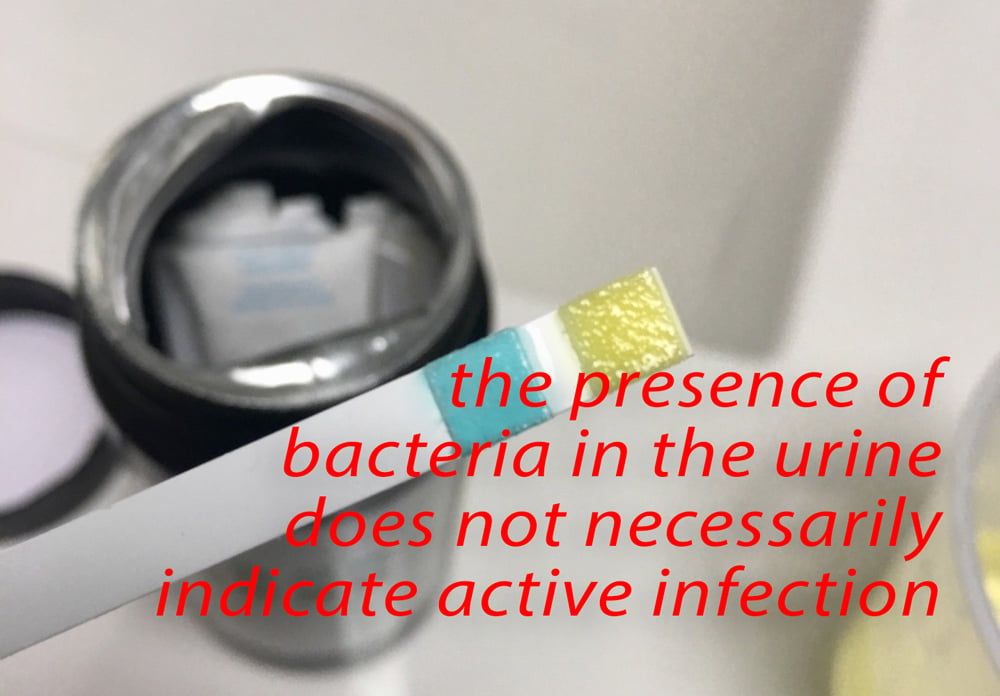
Earlier we get into the culture results estimation, we demand to discuss some potential pitfalls. Commencement, the presence of leaner in the urine does not necessarily betoken active infection, especially in the asymptomatic patient.
Secondly, in women the presence of WBC'due south in the urine without significant bacteria usually represents either an asymptomatic STI (ordinarily Chlamydia), of some other inflammatory response within or adjacent to the urinary arrangement such as pyelonephritis, chronic interstitial cystitis, or even diverticulitis/colitis. Nosotros won't become into these topics here, just I want to make certain that they are in your differential.
To culture or not to culture?
So, now that we accept a UA from a symptomatic patient that indicates infection, do we demand to culture? If the patient has archetype UTI symptoms without evidence of pyelonephritis on physical exam, and they do not accept often recurrent UTI, so they probably do not warrant culture.
Nevertheless, if they take a history of recurrent UTI, or ones that are difficult to care for requiring multiple courses of antibiotics, and then a culture is a skillful idea. Past obtaining a urine culture and sensitivity in these patients, you will be better able to treat your patient effectively without increasing the risk of developing antibiotic resistant infections.
Interpreting Culture Results
Once the C&Due south returns, how practice we interpret it? Well, if you lot have selected your patient population for culture carefully, and then the results should be directly forward. You should have an identified bacterial pathogen with >100,000 CFU/ml and a list of common antibiotic treatments and the ability of those medications to kill the pathogen, the sensitivity.
If yous have prescribed your patient an antibiotic that displays resistance, then notifying your patient and changing medications should be all that is required. The tricky role comes in when you take results that are less clear cut.
Typically, if a patient has archetype UTI symptoms, whatsoever culture that grows greater that 10,000 CFU/ml of a pathogenic bacteria is sufficient. If the result is between 10,000 CFU/ml and 100,000 CFU/ml of typically non-pathogenic bacteria or mixed urethral flora, then either the sample is contaminated or the patient may have a urethral irritation causing symptoms, just not necessarily an infection. Likewise, consider the fact that the patient may have an underlying STI causing the urethritis, and then obtaining a conscientious history is crucial.
Beyond the Automatic Reflex
At present, retrieve that office before about automatic reflex to culture from infirmary laboratories? What if you obtain a UA as role of a generalized "abdominal hurting" work up, even though the patient has no specific urinary symptoms or complaints, and it shows 2+ WBC, is positive for leukocyte esterase, and has three+ squamous epithelial cells? This is the kind of sample that is often reflexed for automatic culture.
However, considering y'all take been thorough in your history taking and examination, too as interpreting the UA, you accept determined that the patient does not have a UTI and that this is a contaminated sample. But the civilisation comes back with 10,000 CFU/ml of E. coli, how do you handle this?
If your piece of work upwards for the intestinal hurting did not reveal a cause, and you lot chose not to treat this contaminated urine sample, the best course of action would exist to contact the patient and run into how they are feeling. If they continue to not have urinary symptoms, are afebrile, and otherwise stable, this can be considered a contaminant and the patient tin be advised to follow upwards for a echo UA. Yet, if they take begun to develop UTI symptoms, then a course of antibiotics is obviously recommended.
Know the Nuances
Laboratory result interpretation, especially urinalysis results, can seem straight forward. Notwithstanding, there is an fine art to it. Information technology is of import to know the nuances of the tests and their results in social club to appropriately treat your patient, and to be a good antibiotic steward. The 'shotgun' arroyo to ordering laboratory tests does non promote skilful patient care or manage costs effectively, especially when asymptomatic patients are treated. Hopefully this can helped clear upwardly some questions virtually urinalysis and urine cultures. In future articles, we will hash out blood cultures and wound cultures and their appropriate uses and interpretations.
Source: https://ppemedical.com/blog/interpreting-culture-results-urinalysis-and-urine-cultures/
0 Response to "what does "this specimen will not reflex to a urine culture" mean?"
Postar um comentário